
The International Orienteering Federation (IOF) has published its Carbon Budget Report for 2025, confirming that the organisation continues to meet its climate commitments while supporting the global development of orienteering.
The report shows that the IOF’s greenhouse gas emissions in 2025 totalled 81.4 tonnes of CO₂ equivalent (tCO₂e), representing 26% of the federation’s 2019 baseline emissions. This means the IOF has once again remained comfortably below its target of keeping emissions under 50% of the 2019 level throughout the period leading up to 2030.
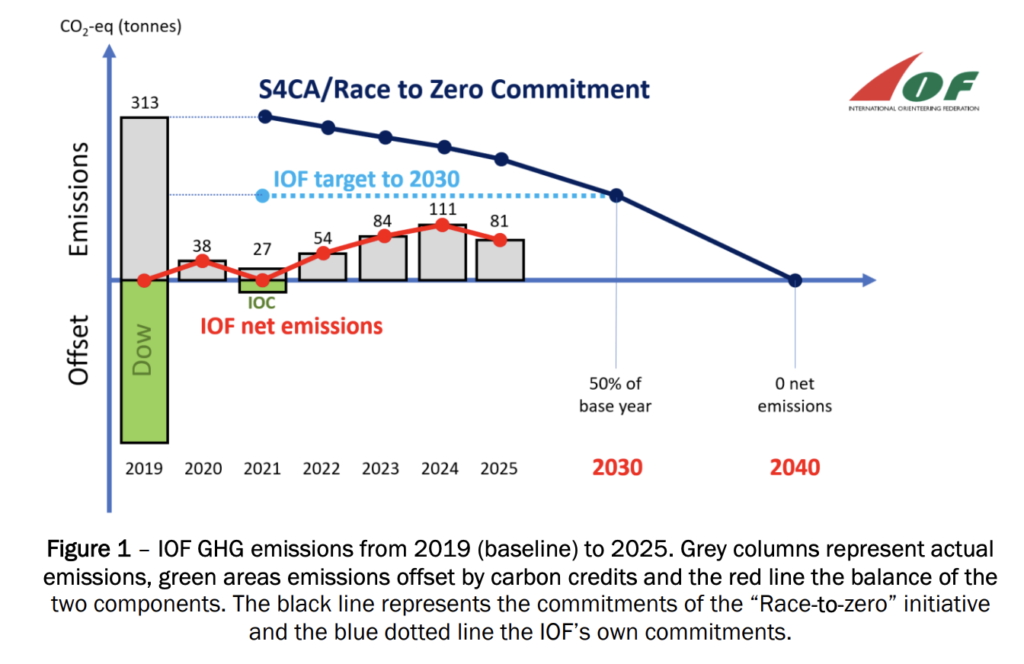
The publication marks the seventh consecutive year that the IOF has publicly reported its carbon footprint, following its commitment to the UN Sports for Climate Action framework and the Race to Zero campaign. The federation remains committed to halving emissions compared with 2019 levels and achieving net-zero emissions by 2040.
Return to 2023 emission levels
After an increase in emissions during the post-pandemic recovery period, the 2025 total returned to approximately the same level as in 2023. The report notes, however, that the reduction compared with 2024 is largely explained by updated international emission factors for aviation rather than a reduction in travel activity.
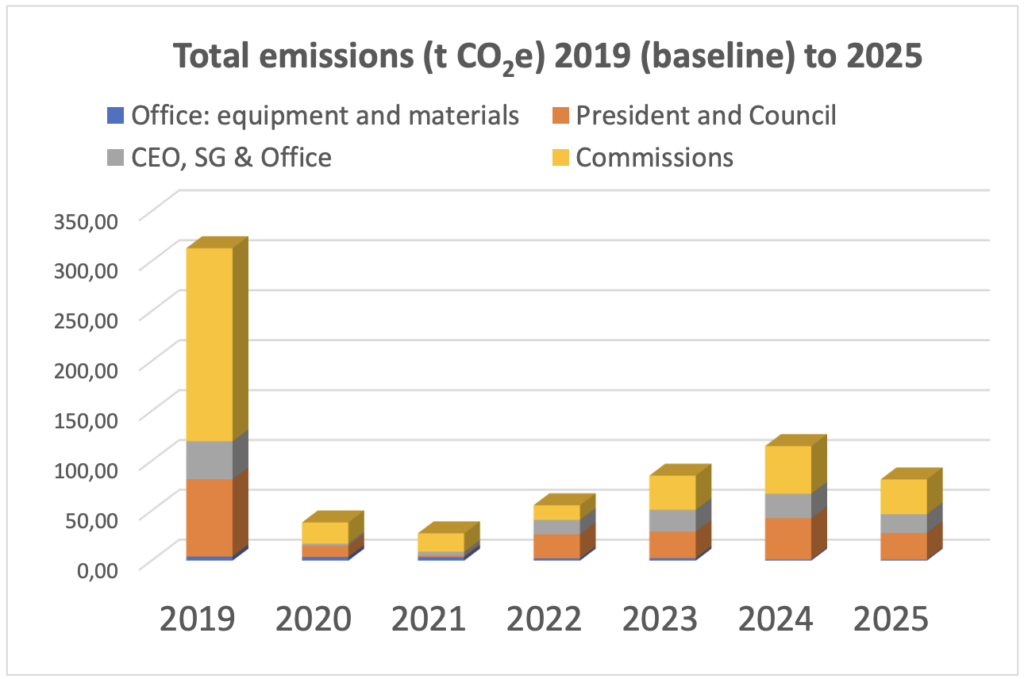
In fact, total air travel distance increased slightly during 2025 as international competitions and development activities continued to expand worldwide. Major activities included the annual Joint Meeting of Council, Office and Commissions in Türkiye and IOF involvement in preparations for and participation in the World Games in China.
Travel remains main source of emissions
As in previous years, travel accounted for the vast majority of the IOF’s carbon footprint. Air travel represented approximately 80% of total emissions and 94% of mobility-related emissions. When hotel accommodation is included, travel-related activities accounted for more than 98% of the organisation’s emissions.
The report highlights the continuing challenge faced by international sports federations: balancing climate goals with the need for global representation, event support and sport development activities.
At the same time, the IOF continues to benefit from measures introduced in recent years to reduce unnecessary travel. Extensive use of digital collaboration tools and videoconferencing has significantly reduced the number of in-person meetings compared with the pre-pandemic period, helping to keep emissions far below baseline levels.